Now Reading: World’s largest cargo drone launched
-
01
World’s largest cargo drone launched

World’s largest cargo drone launched
by HAOYU ZHANG
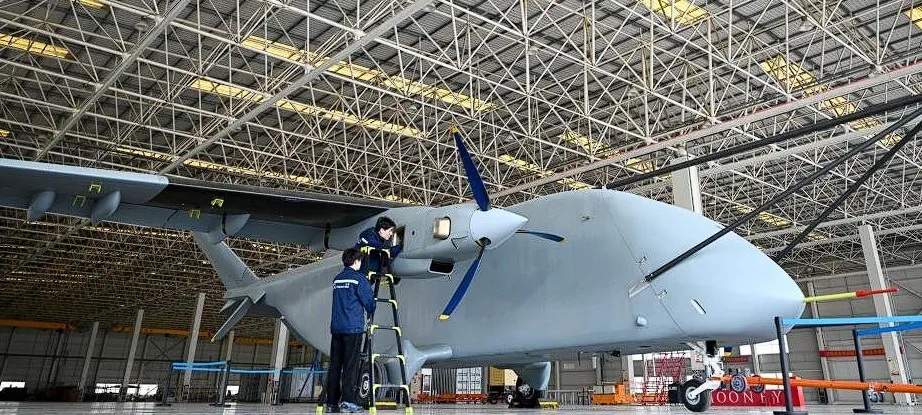
BEIJING – CHINA has taken a significant leap in unmanned aviation technology with the successful maiden flight of the “Changying-8,” now regarded as the world’s largest cargo drone.
This breakthrough highlights the country’s growing leadership in aerospace innovation and signals a major shift in how goods, services, and even military operations may be conducted in the future.
The Changying-8 is an engineering marvel. With a wingspan of 25 meters, it rivals the size of small commercial aircraft.
It can reach altitudes exceeding 10,000 meters, carry payloads of up to 3.5 tons, and travel distances of up to 3,000 kilometers.
These capabilities position it as a powerful alternative to traditional cargo transport methods, especially in areas where speed, efficiency, and accessibility are critical.
One of the most immediate advantages of such large cargo drones is their ability to transform logistics.
In today’s fast-paced, interconnected global economy, businesses depend heavily on reliable and timely delivery systems.
The Changying-8 can bypass congested ports, roads, and airports, delivering goods directly to remote or hard-to-reach areas.
This is particularly valuable for industries such as e-commerce, mining, agriculture, and humanitarian aid, where delays can be costly or even life-threatening.
Moreover, cargo drones significantly reduce operational costs over time. Without the need for onboard crew, expenses related to salaries, training, and human risk are minimized.
Autonomous or remotely piloted systems also allow for round-the-clock operations, increasing efficiency and productivity.
For businesses, this means faster turnaround times, improved supply chain resilience, and the ability to expand into previously inaccessible markets.
In the context of global trade, innovations like the Changying-8 could reshape supply chain dynamics. Countries and companies that adopt such technologies early may gain a competitive advantage, as they can move goods faster and more efficiently than competitors relying solely on traditional transport infrastructure.
This could also lead to a decentralization of logistics hubs, as drones enable direct point-to-point delivery.
The implications extend beyond commerce into the realm of security and warfare.
Large cargo drones can be used for rapid deployment of supplies, equipment, and even personnel in military operations.
They reduce the need for manned transport missions in dangerous zones, thereby lowering the risk to human life. Additionally, their ability to operate at high altitudes and long ranges makes them suitable for surveillance, reconnaissance, and strategic logistics support.
However, the rise of such advanced drones also raises important questions about regulation, airspace management, and security.
Governments and international bodies will need to establish clear frameworks to ensure safe and responsible use, particularly as these aircraft become more widespread.
While it is widely believed that China is currently leading the way with innovations like the Changying-8, the global race in unmanned aviation is likely to intensify.
Other nations may soon follow with similar or even more advanced technologies.
Ultimately, the Changying-8 represents more than just a technological milestone—it marks the beginning of a new era in logistics, business operations, and strategic capabilities.
– CAJ News